
This article was first published on LinkedIn on May 23, 2025. Link to original article.
Electric Aircraft are Hard. Will that Change?
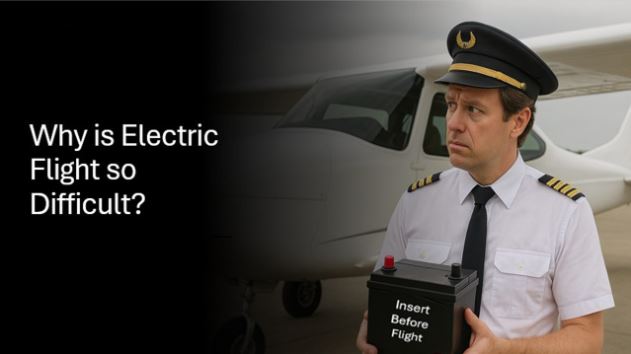
We now see electric cars everywhere, but most people have never seen an electric aircraft. Why is electric flight so hard? There are 4 main reasons:
- Planes aren't just flying cars.
- Batteries are very heavy.
- Aircraft certification is complicated and slow.
- Developing aircraft is expensive!
Let’s expand on each.
Why Planes Aren't Just Flying Cars
It's a statement of the obvious, but also not as obvious as it seems.
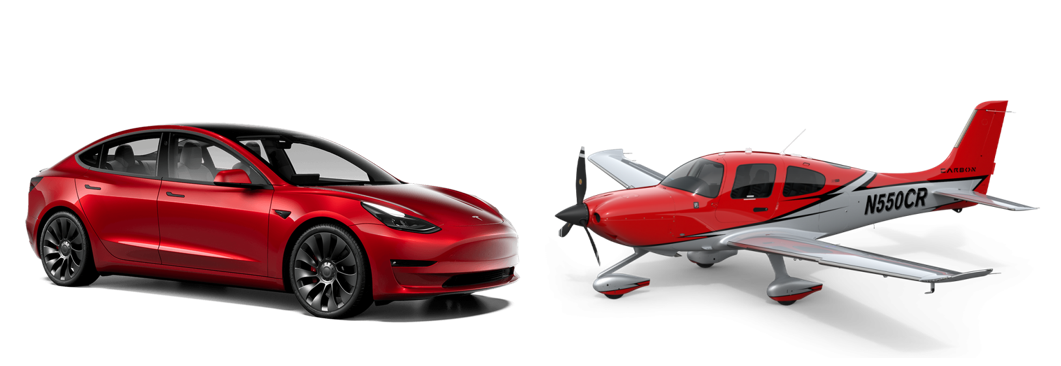
A basic Tesla Model 3 has 283hp, weighs under 2 tons and has a theoretical range of around 500km with a full load of passengers and baggage. Those numbers are not so very different from the world’s best-selling personal aircraft, the Cirrus SR22T. But the car and the plane use power very differently:
Full Power
- Tesla: Almost never uses full power. After 3-4 seconds of max acceleration, it will exceed the speed limit and the passengers will feel carsick.
- Cirrus: Uses full power a lot - typically 5-15 minutes on every flight for takeoff and climb, depending on cruise altitude.
Cruise Power
- Tesla: Uses about 10% of maximum power when cruising at highway speeds.
- Cirrus: Uses 85% power at high-speed cruise (around 3x faster than the Tesla).
Performance with low fuel
- Tesla: Reduced performance is not a problem when the battery's charge level is low.
- Cirrus: Full power must remain available at all times until the aircraft is safely on the ground.
Safety Modes
- Tesla: 'Turtle Mode' lets the car limp to a stop if charge is critical or the battery fails. If there's a fire, the driver can stop and tell the passengers to jump out.
- Cirrus: Turtles don't fly, and passengers can't jump out!
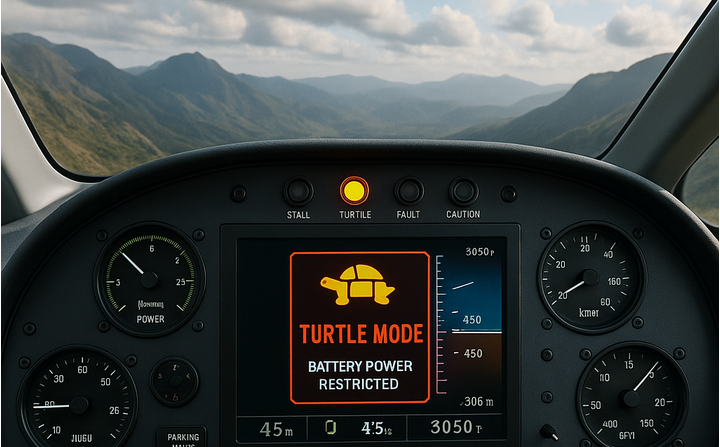
The different ways that cars and planes use power leads to the biggest problem with electric aircraft: battery weight.
Batteries Are Heavy
We don't usually notice the weight of the lithium-ion batteries that power our phones and household appliances, but they are heavy. Scale them up to power an aircraft, and they become extremely heavy.
As a battery delivers power, its temperature rises. The more power you need, the larger the battery must be to avoid overheating.
- Power Density measures how much power (in Watts) a battery can deliver per kilogram of weight (W/kg). It generally sets the lower limit for the weight of an electric aircraft’s battery.
Likewise, the more energy a battery must store, the larger and heavier it gets.
- Energy Density tells us how much energy is stored per kilogram, measured in Watt Hours per kilogram (Wh/kg).
The clever chemistry and movement of Lithium ions take place inside the battery cells. But a full battery system, or battery pack, also includes cooling systems, monitoring and management electronics, safety barriers to isolate overheating cells, structural casing and more.
These components add weight, meaning that battery packs have lower power and energy densities than the cells themselves.
For aircraft installations, the current state-of-the-art is approximately:
- Power Density: ~500 W/kg
- Energy Density: ~200 Wh/kg
Now compare that to liquid jet fuel, which has energy density of 11,900 Wh/kg - almost 60 times better than today's battery packs. It seems like a miracle fuel!
Let’s be optimistic and assume that in the next few years we will achieve 600 W/kg power density, and 250 Wh/kg energy density at the pack level with improved battery technology.
What battery weight would be needed to power 3 conventional aircraft if they switched from burning liquid fuel to batteries?
Let's consider the Cirrus SR22T (a personal aircraft), the Pilatus PC12 (a business and light utility aircraft), and the DeHavilland Dash 8-400 (a regional airliner).
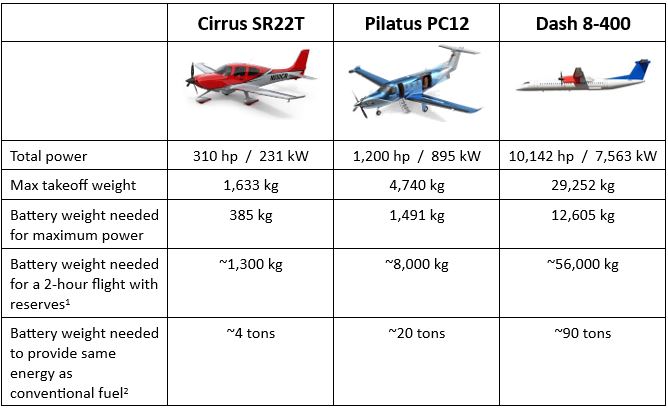
2This is after accounting for engine efficiency. Piston and turboprop engines convert 65-70% of the energy in their fuel into heat.
We can see that even for the Cirrus, battery power isn’t practical. It might work for short training flights of an hour or so, but not for longer journeys. With the larger aircraft, pure battery power simply isn't viable.
Furthermore, in conventional aircraft pilots can reduce the fuel load to improve takeoff performance or carry more payload. But batteries weigh the same whether they are charged or discharged – it’s just the position of some Lithium ions that changes. If the pilot of an electric aircraft needs to reduce weight, the only option is to leave some payload on the ground.
That doesn’t mean that existing aircraft cannot be converted to battery power - but they need to be used differently, for very short journeys where there is no risk of a long hold or diversion. And it can make sense to use an existing airframe just to demonstrate new propulsion technology; it's certainly cheaper than trying to develop a new aircraft at the same time. (Remember that the first Tesla was a modified Lotus sports car; it was heavy, had a short range, and very few were sold. But it paved the way for the Model S, which made Tesla the world’s most valuable car company.)
Aircraft Certification is Complicated, Slow and Expensive
If technology is an unstoppable force, aircraft certification can feel like an immovable object. People complain about that, but certification is a good thing, which (mostly) stops dangerous products reaching the market and killing passengers.
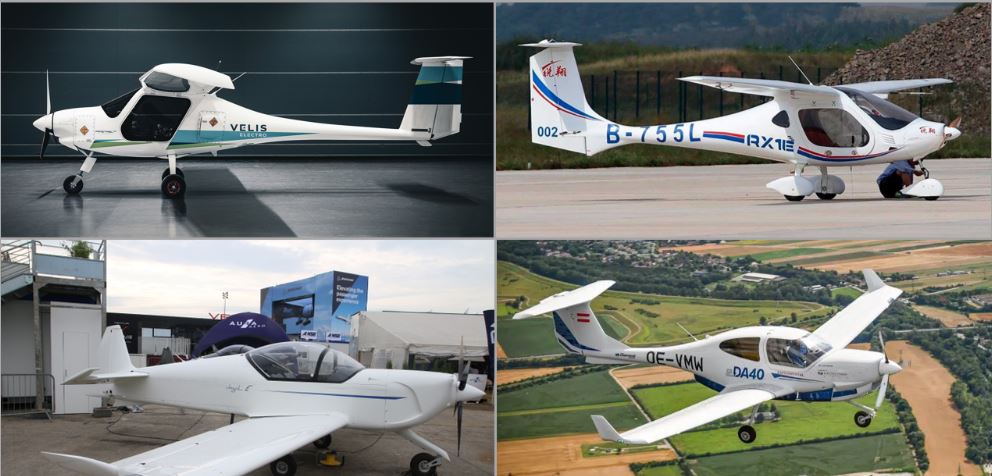
Aircraft developers fully understand the certification rules for conventional aircraft, but for electric aircraft they are still a work in progress. So far, just two electric aircraft have been certified - both very light two-seat training aircraft: the Pipistrel Velis Electro in Europe, and the Liaoning Ruixiang RX1E in China.
For larger aircraft, very few electric aircraft developers have even reached agreement with the regulators (i.e. FAA or EASA) on the certification basis for their aircraft - a critical early milestone that defines the airworthiness standards and any additional "Special Conditions" the new design must meet. Only once this is agreed can the real work of certification begin.
As certification complexity increases, costs increase exponentially. For transport-category aircraft, regulators require that catastrophic failures be shown to occur less than once per billion flight hours. That's an extremely high bar, and proving compliance is both difficult and costly, even for conventional systems. It is harder still when dealing with novel technologies which regulators have never previously been asked to certify.
That means certifying an electric aircraft is slower and more expensive than certifying a conventional one. And, as anyone who has tried it knows, certifying a conventional aircraft is already very slow and very expensive.
Many electric aircraft startups have raised large sums of capital, but most are struggling to certify their products - especially those pursuing ambitious eVTOL designs that combine complex electric propulsion systems with unconventional airframes.
Certification veterans could have anticipated these challenges. For investors, this should be a cautionary tale: technical ambition without a clear path to certification is a recipe for delay, disappointment and financial loss.
Does That Mean the Future isn't Electric?
No, it doesn't! There are many challenges, but batteries will power (or help power) many future aircraft. However, they will need to meet six demanding requirements:
- Light weight (i.e. high energy density), to maximise payload and range.
- High peak power, at all temperatures, for takeoff and climb.
- High continuous power, for fast cruising.
- Peak power output available at low state of charge, to complete flights safely.
- Excellent thermal stability, to avoid runaway events.
- Fault tolerance, to keep flying after partial battery failure.
It’s reasonably easy to build a battery pack that meets some of those requirements, but right now it’s impossible to meet all six.
Aircraft manufacturers and investors need to be aware of the problems, and focus on solutions that can work. Here are some thoughts:
- Keep it simple. We've seen that it's extremely difficult to certify an electric aircraft, and electric power limits performance. But very simple aircraft are easier to certify, and may be economically viable even with limited speed, range or endurance.
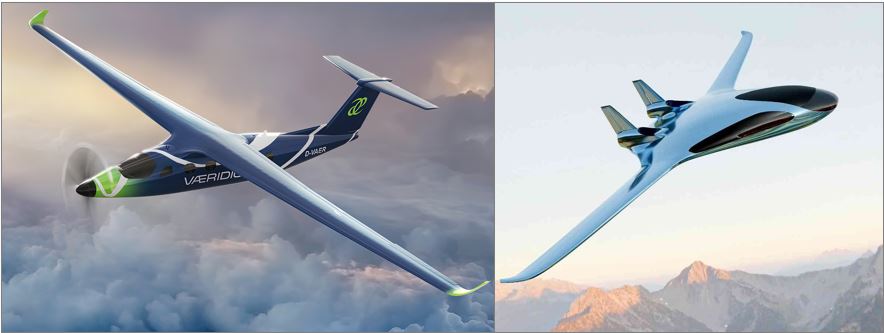
- Design for efficiency. An efficient aircraft with low drag and a relatively low cruise speed will get the most performance from its battery. Extended use of high power will severely impact range and payload. Avoid repeated vertical takeoffs, long climbs to high altitude or very fast cruising speeds.
- Focus on smart thermal management. Better battery cooling allows higher power output and faster recharging, getting more from the same battery mass. It’s the battery equivalent of turbocharging.
- Explore multi-chemistry battery packs. Some battery chemistries offer better energy density, others better fault tolerance or low-charge performance. Combining them, with intelligent battery management, can help meet more of the six requirements.
- Hope for better batteries. Hope is already built into most electric aircraft companies’ business plans! But energy density in lithium-ion batteries is still improving, and solid-state batteries may eventually meet all six requirements. However, they’ve been "just a few years away" for over a decade, so pinning short-term plans on them is risky. Aircraft developers should plan for incremental improvements, and pay attention to the next point!
- Don’t rely on miracle solutions! Three transformational technologies are often discussed: supercapacitors, Lithium-Sulphur (Li-S) and Lithium-Silicon (Li-Si) batteries. They all have big problems. Some eVTOL developers have proposed using supercapacitors for short bursts of takeoff power, but while they have excellent power density, supercapacitors have terrible energy density. Li-S batteries offer high energy density and have performed well in long-endurance UAVs, but they suffer from short cycle life, meaning they degrade quickly with repeated charging and discharging. Li-Si batteries could deliver game-changing energy density, but they undergo extreme volume changes during charging and discharging, which leads to mechanical instability and rapid performance loss.
- Use Hybrid systems. The most practical near-term solution may not be all-electric, but hybrid - like the original Toyota Prius. A conventional engine (burning sustainable fuel - definitely not hydrogen!) can provide power when needed and recharge the battery at low demand. This would allow reduced battery weight while retaining range and payload capacity. It’s a viable path to lower emissions and commercially viable capability, without waiting for a battery breakthrough.
So What’s Next?
Electric aircraft are coming - but perhaps not in the way that many current development projects would suggest. We won't be seeing fleets of autonomous electric air taxis or battery-powered airliners flying across oceans any time soon.
But here's what we can realistically expect:
- Battery-electric light aircraft for training and recreation.
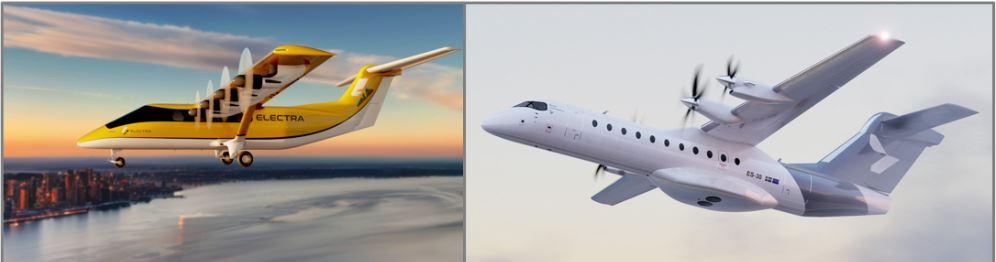
- Hybrid-electric regional aircraft, with very efficient aerodynamics and slower cruise speeds than conventional aircraft.
- Battery and hybrid systems retrofitted to some older aircraft. Pure electric aircraft will have very limited range. Hybrid retrofits are more likely to be commercially viable.
- Steady improvements in battery performance, safety, and charging.
- Possibly a step-change when solid-state batteries arrive at scale.
- Slow progress on certification.
- Many start-up failures.
- Hopefully, a few big winners!
Electric aviation isn't just a fad or a fantasy – even if some of the more esoteric eVTOL projects make it seem like that. But it will take time, realism, and incremental improvements through rigorous engineering. The winners will be those who stay grounded in physics and certification, and who focus on meeting transport needs that people will pay for.
About the Author: Adrian Norris
Adrian Norris is an aerospace advisor with over 30 years of international experience spanning strategic consulting, aviation and space startups, aircraft development and certification, and corporate leadership. He works with investors, founders, and executives to shape strategy, assess feasibility and risk, and distinguish real opportunities from industry hype.
Adrian co-founded an aircraft development company and brings a unique blend of technical and commercial insight. He trained as a chemist, holds a Master’s degree in Leadership and Strategy, and is a licensed commercial pilot.
Contact
Get in touch to discuss a current project or investment.
We provide independent, evidence-based analysis to support investment and strategic decisions.