
This article was first published on LinkedIn on April 16, 2025. Link to original article.
Hydrogen is NOT the Future for Aviation!
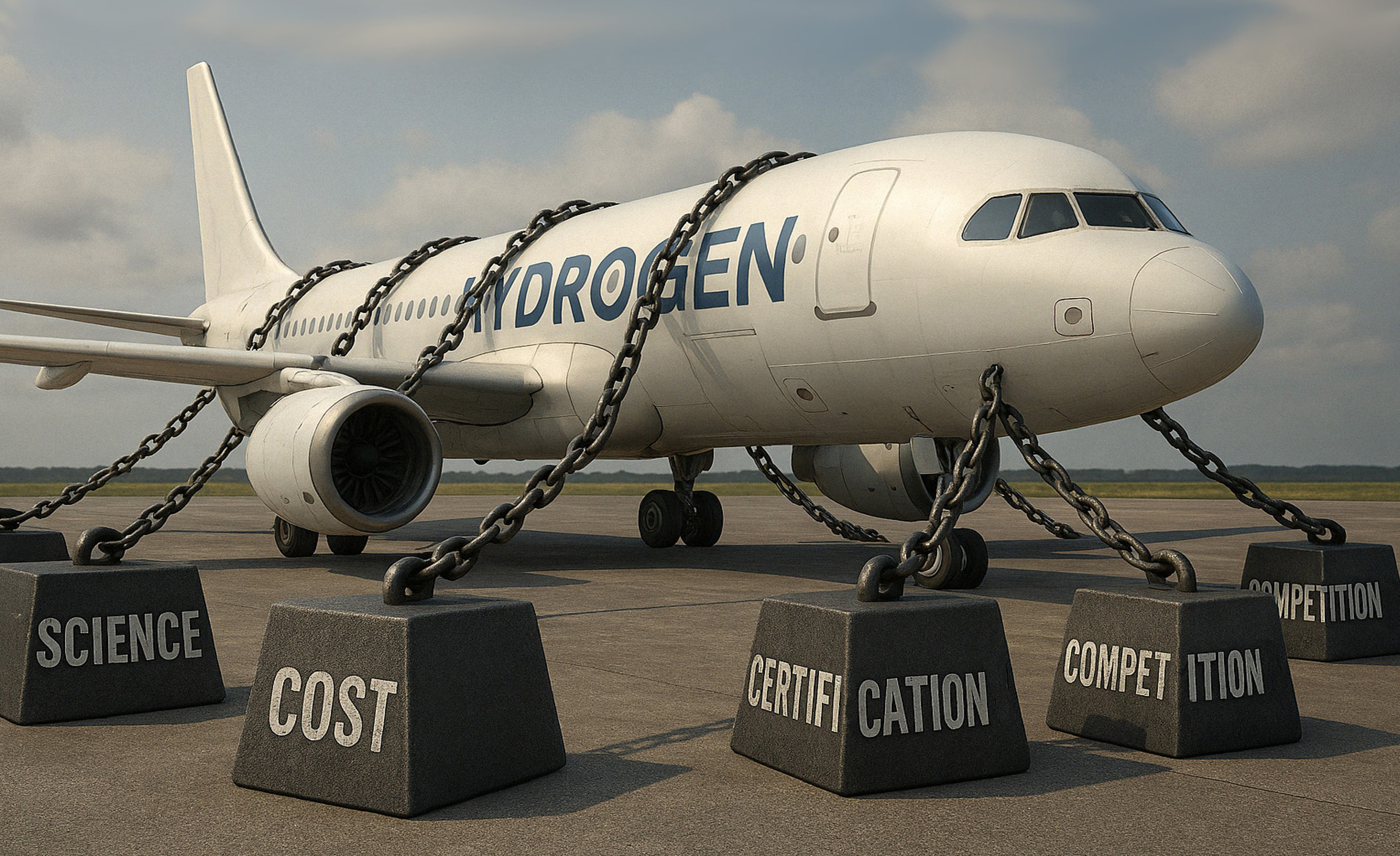
In April 2025 a sustainable aviation conference was held in Friedrichshafen, Germany1. Three quarters of the presentations focused on hydrogen.
The enthusiasm for hydrogen is understandable. Who wouldn’t want aircraft that only emit water? The EU and national governments have allocated many billions of euros in grant funding to support hydrogen technologies. Some of this money has benefited aviation startups.
Those startups employ talented engineers and attract investors focused on clean technologies who may be willing to accept lower or slower returns than investors in other sectors.
Zero-emission aircraft + lots of grant funding + brilliant engineers. What could go wrong?
Almost everything could go wrong!
Hydrogen is not the future for aviation. To understand why, let’s look at the challenges in these categories:
- Physics
- Economics
- Logistics
- Certification
- Pollution
- Competition
Physics
Hydrogen contains almost 3 times as much energy as jet fuel by weight2. But not by volume.
At atmospheric pressure, 1kg of hydrogen fills 10,000 times the volume of 1kg of jet fuel. It is useless in this state - except as lift for highly flammable airships.
Pressurised to 700 atmospheres / 10,000 psi, hydrogen needs 7 times more volume than jet fuel for equivalent energy. But that’s before you add the armoured storage tanks that can withstand such high pressures. Those tanks are large, heavy and awkwardly shaped. They would have to be carried in the fuselage of an aircraft, which is where operators generally prefer to put passengers.
Liquid hydrogen is better, but still needs almost 4 times more volume than jet fuel for equivalent energy. But that’s before you add the cryogenic storage tanks that can store hydrogen below its boiling point of minus 253°C. There still won’t be much room for passengers.
There can never be a technical solution to the storage problems for gaseous or liquid hydrogen. The fundamental properties of hydrogen define how much volume it needs.
Hydrogen can be stored as a solid metal hydride, for example in LaNi₅H₆ (lanthanum–nickel alloy). This is easier to store, but has many other problems as an aircraft fuel which I will address in a future article.
Staying on the physics problems, hydrogen is the smallest molecule and it gets everywhere. It leaks through seals and escapes from storage tanks. Worse, it permeates into metals like steel and titanium making them brittle. It doesn’t affect aluminium which is the most widely used metal in aircraft, or many steel alloys, but metals that are susceptible are used extensively and this issue will create risks and certification challenges.3
The final physics problem is how to make hydrogen. If the object is flight with zero carbon emissions, then we obviously need zero-emission hydrogen manufacture – which requires electrolysis of water using electricity from renewable sources to produce so-called ‘green’ hydrogen.
Water molecules really want to stay together, so it takes a lot of energy to break the chemical bonds and separate water into its constituent elements. This is a fundamental thermodynamic limit that will not be improved by some future technical breakthrough. Technology might make electrolysis more efficient, but we can’t change the thermodynamics.
Economics
‘Green’ hydrogen is expensive. Boston Consulting Group estimates production costs in the range of €5 to €8 per kg by 2030 in Europe4. This very optimistic estimate assumes a significant reduction in current electricity prices, but let’s use the mid-point of BCG’s estimate and assume a price of €6.5 / kg.
The gas produced by electrolysis then needs to be compressed, liquefied and transported.
It takes 50-55kWh of electricity to produce 1kg of hydrogen, then a further 10-15kWh to liquefy it. Liquefaction would cost another €1.5/kg, so we're at €8 / kg just to produce liquid hydrogen. It then needs to be taken to the point of use by tanker – which is expensive: a US Department of Energy study in 20205 estimated tanker costs of around $8 / kg (€7 at the time of writing). Delivering hydrogen short distances to aircraft at airports might be cheaper than this, but the saving would be more than offset by the costs of on-site liquid hydrogen storage.
Ignoring the capital cost of electrolysis plants, or any new power generation plants, and ignoring profit margins, we’d have a price of €15 / kg once hydrogen is delivered to an aircraft’s fuel tanks. But remember, hydrogen leaks through gaps that other gases can’t find. Being optimistic, let’s assume that 1.1kg of hydrogen needs to be produced for every 1kg that is loaded into an aircraft’s fuel tank.6
So we have a cost of €16.5 per kg of hydrogen for production, liquefaction, and transport - with a small allowwance for leakage.
Jet fuel currently costs around €0.65 / kg.
For equivalent energy content, green hydrogen is 9 times more expensive. Airline ticket prices would need to be tripled to cover the extra cost. That would kill the airline industry.
Hydrogen evangelists say that we should make hydrogen in places where renewable power could be generated cheaply, for example by solar power in sunny deserts, hydro-electric power in remote mountains or geothermal power anywhere that it can be accessed. That is a weak argument. We should certainly generate electricity in these places, but it will always be cheaper to put that electricity into a wire and send it where it’s needed, rather than converting it inefficiently to hydrogen, transporting it at high cost, losing some of it to leakage, then converting it inefficiently back to electricity.
Logistics
Power generation
Let’s imagine that all the flights leaving London’s Heathrow airport used hydrogen instead of jet fuel. How much hydrogen would we need?
Heathrow uses around 22 million litres of jet fuel each day7, which has the same energy content as 6,914 tons of hydrogen, allowing for 10% leakage.
To produce that much hydrogen by electrolysis, then liquefy it would take 450 million kWh8. That would require a continuous 19GW power supply9. The UK’s current renewable electricity generating capacity is 25.6 GW10, achievable only in optimal conditions for wind, solar and hydro power generation.
Using 74% of the country's renewable power generating capacity to enable flights from just one airport is obviously never going to happen.
Let’s look at it another way. The UK currently uses around 38 million litres of jet fuel per day across all its airports11. If one third of that was replaced by hydrogen, just over 4,000 tons of hydrogen would be needed every day. Over a whole year, that would require 95 TWh of electricity.12
In 2023, the UK generated 96.2 TWh from wind and solar power10. So we would need to use the country's entire renewable power generation capacity to replace one third of the UK's jet fuel with hydrogen. It isn’t going to happen.
Hydrogen storage
It is best to produce hydrogen where it is needed, rather than transport it through pipelines (due to capital cost and leakage) or in large fleets of tankers (because we would need thousands of them), so large electrolysis plants would need to be built at airports. Let’s ignore the planning challenges, the space that’s needed, the electricity supply problems, the backup systems, the disaster management challenges and much more, and just focus on one issue: storage of hydrogen at airports.
As renewable power is used for electrolysis to produce ‘green’ hydrogen, airports will need to keep a reserve of hydrogen for when weather conditions limit generating capacity. Let’s be generous and assume that a 24-hour reserve supply is sufficient (which it wouldn’t be).
The world’s largest liquid hydrogen tank is used to fuel the Artemis rocket at NASA’s Kennedy Space Center. It is a masterpiece of engineering which took 4 years to build and cost many millions of dollars. It holds 330 tons of liquid hydrogen.
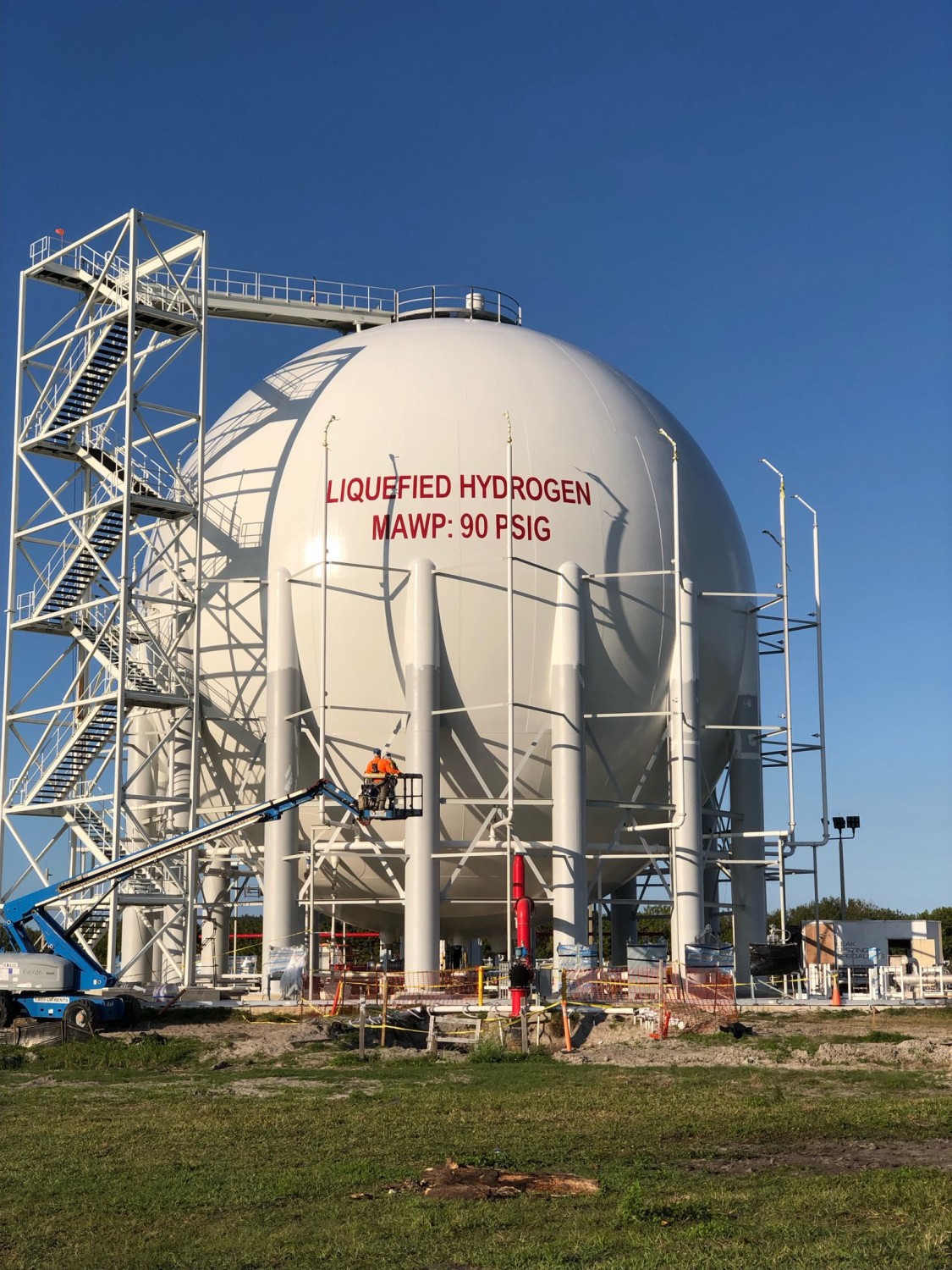
Using our hypothetical example of hydrogen replacing jet fuel at Heathrow, storage of 24 hours’ fuel would need 21 liquid hydrogen tanks similar to NASA’s. Even a small airport handling a fraction of Heathrow’s flight numbers would need hugely expensive cryogenic storage tanks.
How expensive? Well, using low-end estimates, tanks to store 7,000 tons of hydrogen would cost about €200 million to build, and realistically an additional €500k per week to operate.13
Once again, it isn’t going to happen.
Hydrogen also needs to be moved from airport storage tanks to the aircraft. A large jet fuel tanker has a capacity of 65,000 litres. By comparison a large liquid hydrogen tanker has a capacity of 40,000 litres (lower capacity due to the thick insulation). 40,000 litres of hydrogen hold the same amount of energy as 9,929 litres of jet fuel - so airports would need roughly 6 times as many tankers to refuel hydrogen-powered aircraft.
Aircraft Certification
Aircraft certification is slow and expensive. Regulators (e.g. FAA or EASA) require extensive proof that any new aircraft is safe. It is easier to certify a new aircraft that is very similar to existing aircraft: designers, engineers and the regulators understand the potential issues and know what works and what doesn't.
But nobody has ever certified a hydrogen-powered aircraft. They have intrinsic challenges that are new to both aircraft companies and regulators.
- Hydrogen fuel cells are temperamental and can stop working if there are impurities in the hydrogen fuel.
- Fuel cells produce water that could freeze at high altitude or cause corrosion and short circuits.
- Liquid fuel tanks need to be safe in all foreseeable scenarios (in a crash, nobody wants the cryogenic fluid to flash freeze all the passengers a fraction of a second before it ignites and incinerates them!).
- It must be impossible to spill liquid fuel onto a component that could be damaged by the -253°C temperature.
- It must be impossible for hydrogen gas to permeate and render brittle any susceptible metal component.
- The aircraft must have maintenance and operating procedures that can be followed safely by mechanics and pilots of average skill, even if they’re having a bad day.
- And so on and so on.
There are currently no certification standards for hydrogen-powered aircraft, so each certification project would have to be approved under 'special conditions', agreed on a case-by-case basis between the aircraft manufacturer and the regulator. The lack of agreed certification standards for aircraft, and for critical subsystems like fuel cells or hydrogen-burning jet engines, will make certification very slow and very expensive.
There’s no doubt that the engineers working at some hydrogen aircraft companies could solve these issues, but probably not before their employers run out of money. The companies developing hydrogen aircraft will have to educate themselves, then educate the regulators, then prove by analysis and testing that their products are safe. It isn’t going to happen.
It is a sure bet that all the startup companies engaged in hydrogen aircraft development will abandon the attempt, pivot to something different, or go bankrupt.
Pollution
The strongest argument in favour of hydrogen power is the lack of pollution. When hydrogen is mixed with oxygen in a fuel cell, it produces electricity and water that is pure enough to drink. And when it is burned in a jet engine, it produces heat and water. So why do I raise pollution as a concern?
First, because hydrogen is an indirect greenhouse gas, and because so much hydrogen will leak to the atmosphere long before it reaches a fuel cell or jet engine.
Hydrogen reacts with hydroxy radicals (HO•) and this prevents them from breaking down methane, which is a powerful greenhouse gas, so methane lingers in the atmosphere for much longer than it would in the absence of hydrogen. The product of this reaction then causes further reactions that increase the concentration of ozone in the troposphere – another powerful greenhouse gas.
These effects cause hydrogen to have a global warming potential that is 37 times higher than the same mass of CO2 over a 20-year period14. Because hydrogen is so light, the mass released to the atmosphere through leakage is low compared to the mass of CO2 produced by burning conventional fuels, but the effect is not negligible, particularly when less polluting alternatives are available.
Second, hydrogen used in a jet engine burns at a very high temperature (>1,500°C). As it burns, hydrogen is oxidised to water, but the temperature is so high that nitrogen in the air is also oxidised to nitric oxide and nitrogen dioxide (collectively referred to as NOx) – greenhouse gases that cause breathing difficulties and smog when emitted at low altitude.15 Hydrogen jet engines would produce less than half the NOx emissions of a conventional jet, but NOx would remain a significant pollutant.
Competition
So, if hydrogen has very poor energy by volume, is expensive, difficult to transport, difficult to certify and not as clean as people think, is there a better option?
Yes!
Batteries and Biofuel.
For short-haul flights, and for some light aircraft, battery power will be better. Batteries in electric vehicles are very heavy, but technology is advancing rapidly. Batteries with energy densities that are 4 times higher than current car batteries are being tested. They have challenges and they are not yet ready for production, but hybrid solutions are available now offering low emissions and capability that will continue to improve as battery technology develops.
Batteries can be charged at over 95% efficiency, using renewable energy that has been transported long distances using existing infrastructure with negligible 'leakage'. Perhaps 85% of the stored power can then be converted to mechanical energy by the aircraft’s motors and propellers. This compares with 70-80% efficiency of hydrogen electrolysis, 50-60% efficiency of hydrogen liquefaction, 40-60% efficiency for hydrogen fuel cells, and significant leakage at every point.
Converting electricity to hydrogen, compressing or liquefying it, transporting it, then converting it back to electricity brings big losses at every step.
For medium and long-haul flights, biofuel is the obvious solution. It allows us to continue using existing aircraft engines and refuelling infrastructure. It costs more than fossil fuels today because we choose not to tax fossil fuel for its climate impact. But it is a significantly cheaper option than hydrogen.
Conclusion
For investors, the advice is unambiguous.
Smaller aircraft, up to short-haul airliners, will gradually be replaced by new battery and hybrid-powered aircraft. There are some great companies working on those projects, and there’s money to be made supporting the transition to electric power. Large aircraft will be able to carry on flying long-haul just as they do today, using biofuel with net zero climate impact. Again, there’s money to be supporting the development of biofuel production and distribution.
Hydrogen-powered aircraft will go nowhere. Governments will continue to throw grant funding at them for a long time to come, but savvy investors should not be misled. Hydrogen-powered aircraft will remain grounded by the physics, economics and certification complexity, and they will be overtaken by better options – just as has happened with hydrogen-powered cars and trucks.
A final point: all the arguments against hydrogen-powered aircraft also apply to hydrogen-powered cars, trucks, trains, bulldozers, and ships! Hydrogen has its uses, but transport isn't one of them.
Invest at your peril!
About the author:
Adrian Norris is an Aerospace consultant who specialises in helping investors make informed decisions and minimise risk. He has advised companies, private investors and VC funds in the US, Europe and China on investment in hydrogen aircraft and UAV projects. He was the co-founder of an aircraft development company and a satellite imaging company. He has a degree in Chemistry and is a Sloan Fellow of the London Business School.
Notes:
(1) https://www.aero-expo.de/conferences/hydrogen-and-battery-summit
(2) Hydrogen: 120 MJ / kg. Jet A1 fuel: 43 MJ / kg
(4) https://media-publications.bcg.com/Turning-the-European-Green-H2-Dream-into-Reality.pdf
(8) 22 million litres = 17.6 million kg of jet fuel. Allowing for 10% leakage, that’s equivalent to 6.9 million kg of hydrogen. Assume 65 kWh to produce and liquefy 1kg of hydrogen.
(9) 450 million kWh divided by 24 gives 18.7 GW power needed, rounded to 19 GW.
(10) https://assets.publishing.service.gov.uk/media/66a7da1bce1fd0da7b592f0a/DUKES_2024_Chapter_5.pdf
(11) https://www.theglobaleconomy.com/United-Kingdom/jet_fuel_consumption/
(12) 240,840 barrels of fuel per day is 38.3 million litres per day. Calculations as in point (8) above.
(14) https://www.nature.com/articles/s43247-023-00857-8
(15) https://www.energy.gov/eere/fuelcells/does-use-hydrogen-produce-air-pollutants-such-nitrogen-oxides
Contact
Get in touch to discuss a current project or investment.
We provide independent, evidence-based analysis to support investment and strategic decisions.