
This article was first published on LinkedIn on December 11, 2025. Link to original article.
ZeroAvia Reality Check

This article looks at what ZeroAvia has claimed, what it has achieved, and how far it remains from certification and commercial viability.
ZeroAvia was founded in 2018 by Dr. Val Miftakhov, a Russian-American physicist, private pilot, and serial entrepreneur. The company aims to develop the world's first zero-emission engines for commercial aviation.
After initial work in America, ZeroAvia moved most activities to the UK. The move unlocked significant public funding. The company has announced:
- £41.5m UK government grants awarded
- €21m EU grants awarded
- $7.75m US grants awarded
- £8.5m in UK R&D tax credits
- £52m equity investment from the British and Scottish governments
However, ZeroAvia's latest accounts say there is "material uncertainty" about its ability to continue as a going concern. More funding is needed to continue operations beyond Q1 2026.
ZeroAvia is cutting staff in the US and UK. In recent weeks, a number of senior engineers have announced their departure or marked themselves 'Open to Work'. These were critical roles for development and certification. So ZeroAvia's fundraising will take place in very difficult circumstances.
Against this backdrop, investors and governments will need to understand whether the company is genuinely close to delivering a certified hydrogen-electric powertrain - or whether the development claims are exaggerated.
First, a note about being a critic
It is easy to criticise from the sidelines with the benefit of hindsight. Easier still to amplify rumours and hearsay.
Developing a new aviation powertrain is hard. It requires deep technical capability and substantial capital over a long development cycle. Any company attempting this deserves recognition for the scale of the challenge.
To avoid unfair commentary, this article relies on ZeroAvia's own material: press releases, company videos and interviews, publicly filed accounts, public communications by employees, evidence submitted to the US Senate and UK Parliament, and company information that was made public in an aircraft accident report.
There is no speculation about motives, just a review of claims and evidence.
Consistently over-optimistic timelines
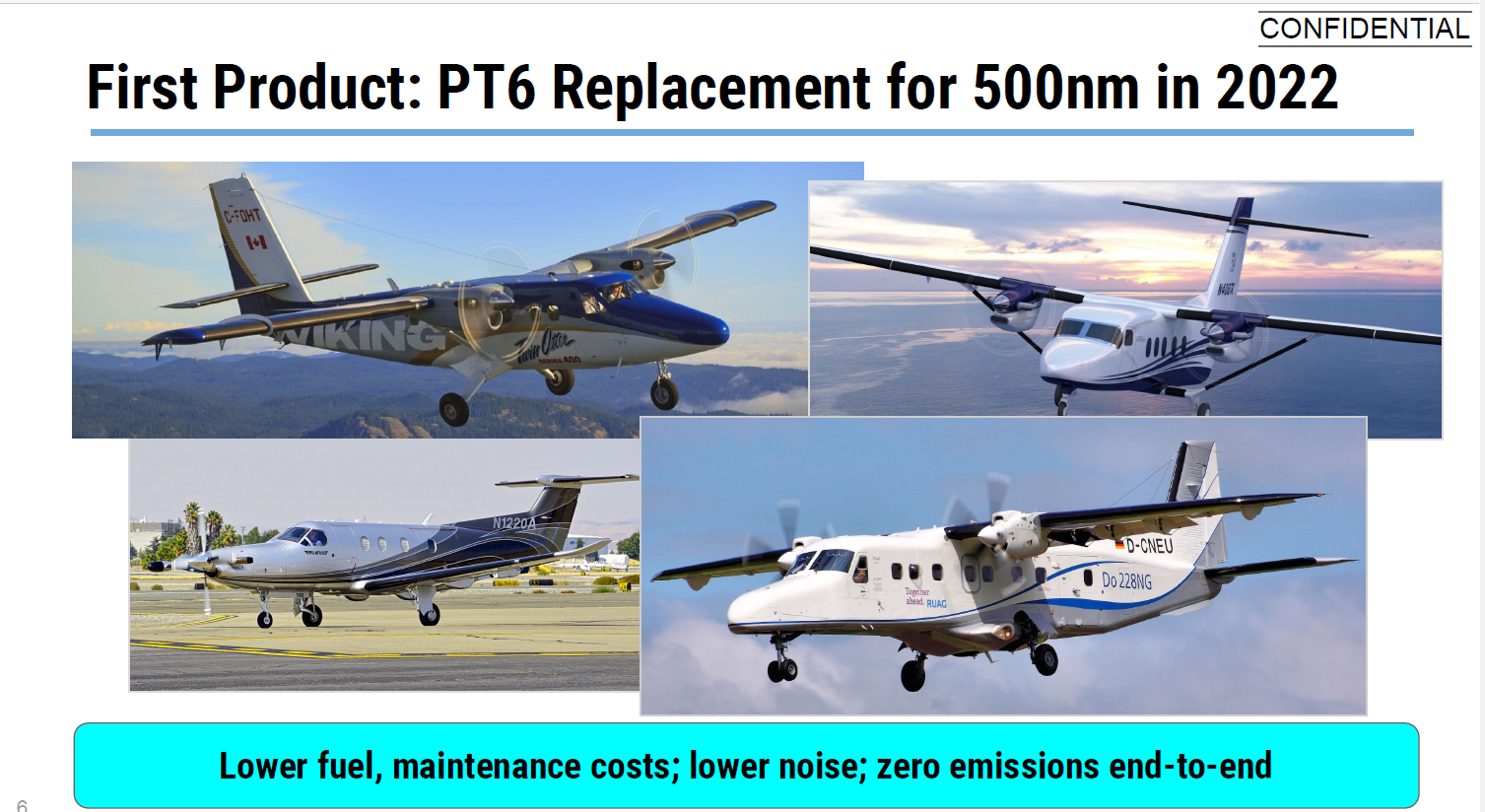
ZeroAvia has repeatedly stated that commercial hydrogen-electric aviation was just two or three years away. In 2019, the company announced that a hydrogen-powered replacement for the PT6 turboprop would be flying 500 nautical miles by 2022:
- The following year, 2020, commercial launch slipped by a year to 2023.
- In 2021, ZeroAvia said commercial flights between London and Rotterdam would begin in 2024.
- In March 2023, a US Senate committee was told "by 2025, we anticipate commercial service [...] delivering zero-emission cargo and passenger flights.”
As recently as July 2024, ZeroAvia's press releases claimed it would "support a 300-mile range in 9–19 seat aircraft by the end of 2025". (See 'About ZeroAvia' section.)
At the same time, ZeroAvia made claims about powertrains for larger aircraft:
- In 2020: fly 80-seat aircraft over 500 miles by 2026.
- In 2021: fly 90-seat aircraft over 1,000 miles by 2026.
- In 2023 and 2024: fly 40-80 seat aircraft 700 miles by 2027.
- In 2023, ZeroAvia claimed its "prototype ZA2000 hydrogen-electric system for 40-80 seat regional turboprop aircraft is soon to be tested aboard a 76-seat Dash 8-400, with a target of certifying the technology for use as early as 2027".
None of these claims were realistic. The current claim, according to a November 2025 press release is that commercial operations will begin in 2028. Based on the evidence presented below, that timeline is not credible.
HyFlyer 1 - 250kW powertrain demonstrator
ZeroAvia's HyFlyer 1 project used a modified Piper PA46 Malibu to demonstrate hydrogen-electric propulsion. The project received extensive publicity:
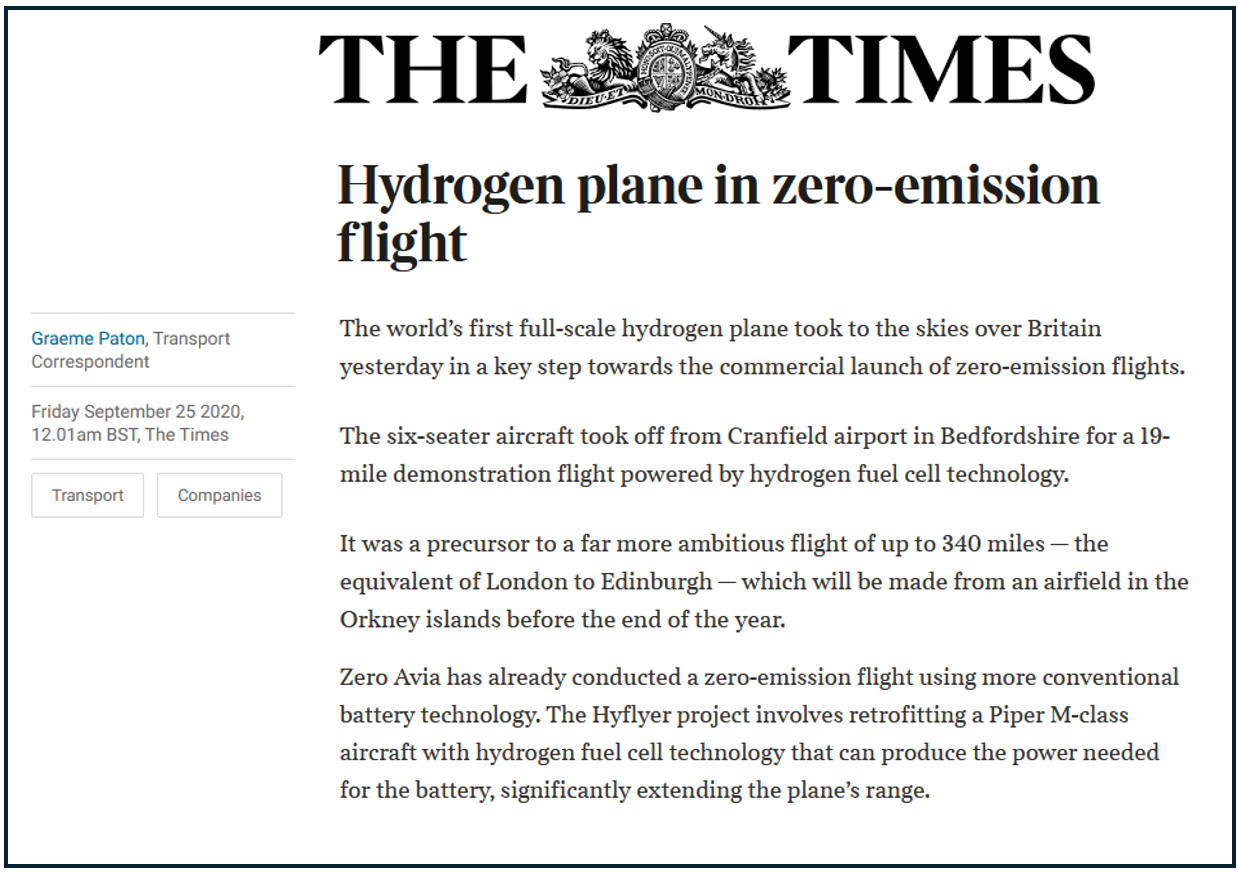
ZeroAvia said that the aircraft's first flight in September 2020 would be followed by a "250 mile zero emission flight out of an airfield in Orkney before the end of the year". A press release in December 2020 said to expect a "long-distance flight of 250 miles in the next three months". That was an impossible claim, as the aircraft was incapable of flying 250 miles.

Evidence presented by ZeroAvia to the UK Parliament in January 2021 claimed that "In early 2021, ZeroAvia will achieve a further significant milestone, with a long-distance UK domestic flight of approximately 300nm".
ZeroAvia said that HyFlyer 1 "successfully demonstrated a 250kW powerplant in a 6-seat aircraft." The passenger seats had, in fact, all been replaced with hydrogen tanks and batteries, while the powertrain developed 200kW.
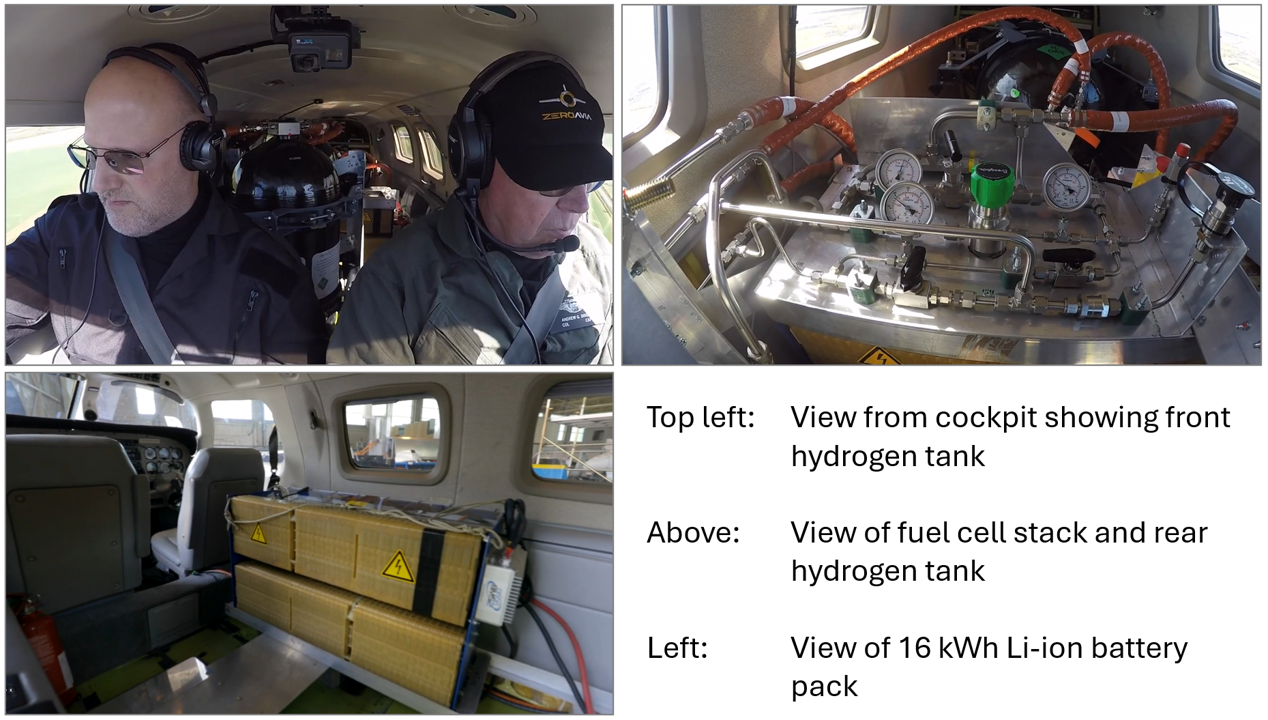
HyFlyer 1 was destroyed in an accident on April 29th, 2021. The report by the UK Air Accidents Investigation Branch (AAIB) made clear that:
- The powertrain comprised a 100kW fuel cell, and 100kW lithium-ion battery pack.
- The aircraft was incapable of flying 250 miles.
- It was being tested to allow a flight of 60 miles to ZeroAvia's new operating base, where larger hydrogen tanks would be fitted to allow longer flights.
- Flights were only authorised within 2 miles of Cranfield airport.
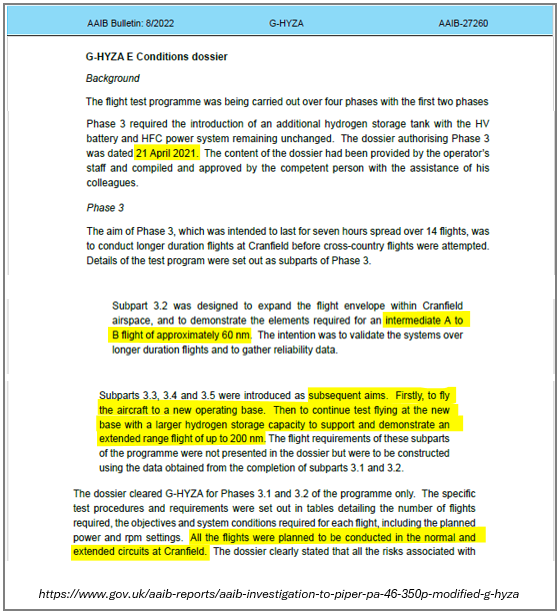
The gap between claims and reality for HyFlyer 1 are concerning.
HyFlyer 2 - 600kW powertrain demonstrator
HyFlyer 1 was followed by HyFlyer 2 - a twin-engine Dornier 228 turboprop. The left engine has been replaced by a prototype of ZeroAvia's ZA600 powertrain. ZeroAvia's 2023 brochure makes clear this is a 600kW hydrogen fuel cell system:
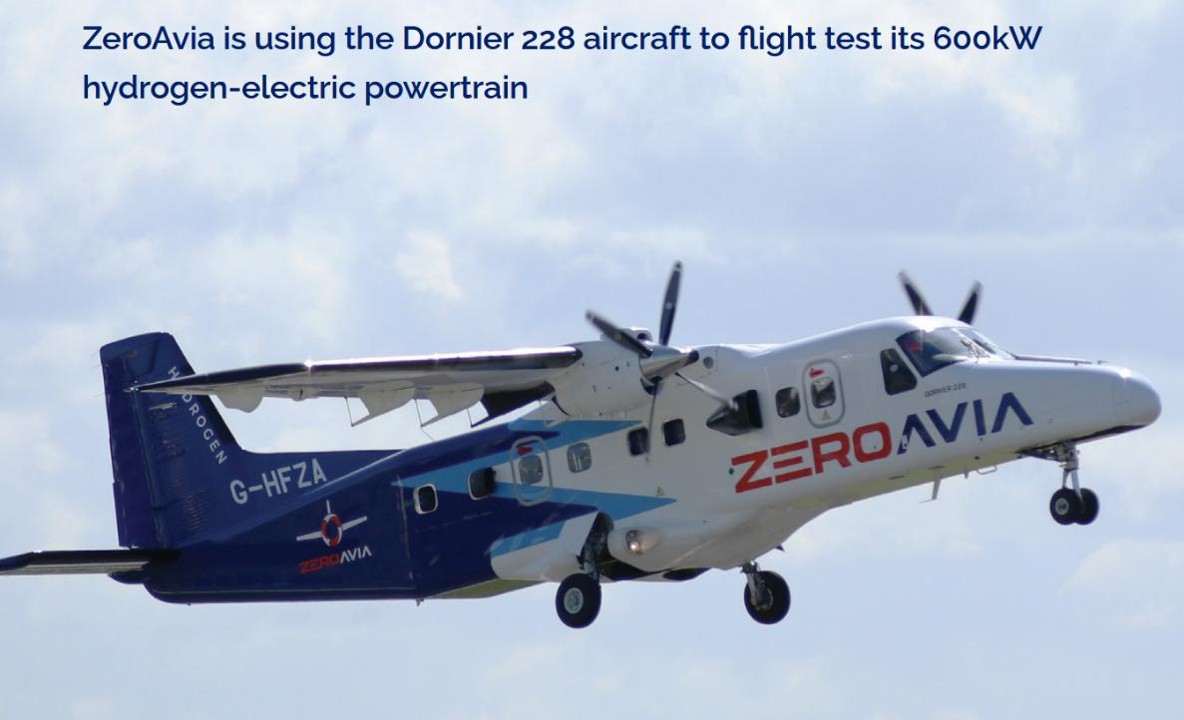
The first flight of this aircraft was widely reported, but ZeroAvia's claim that it moved them "forward on the way to meeting target of commercial flights using only hydrogen fuel cell power by 2025" was exaggerated.
A presentation to the UK Royal Aeronautical Society (RAeS) by ZeroAvia staff gave details of the powertrain:
- Total power is 400 kW.
- Power is supplied by a 900kg LiFePO₄ battery pack, and two hydrogen fuel cell stacks.
- Each fuel cell stack generates 120kW, so total power from hydrogen is 240kW.
- The fuel cells and hydrogen tank weigh 450kg.
- The hydrogen tank holds 5kg of gaseous hydrogen at 350 bar.
- Asked about efficiency, the ZeroAvia team said that power produced is "around 10 to 15%" of the energy stored in the hydrogen.
Pictures of the cabin show the hydrogen tank on one side and the batteries on the other. The fuel cell stacks are at the rear, shown in the view from outside the aircraft.
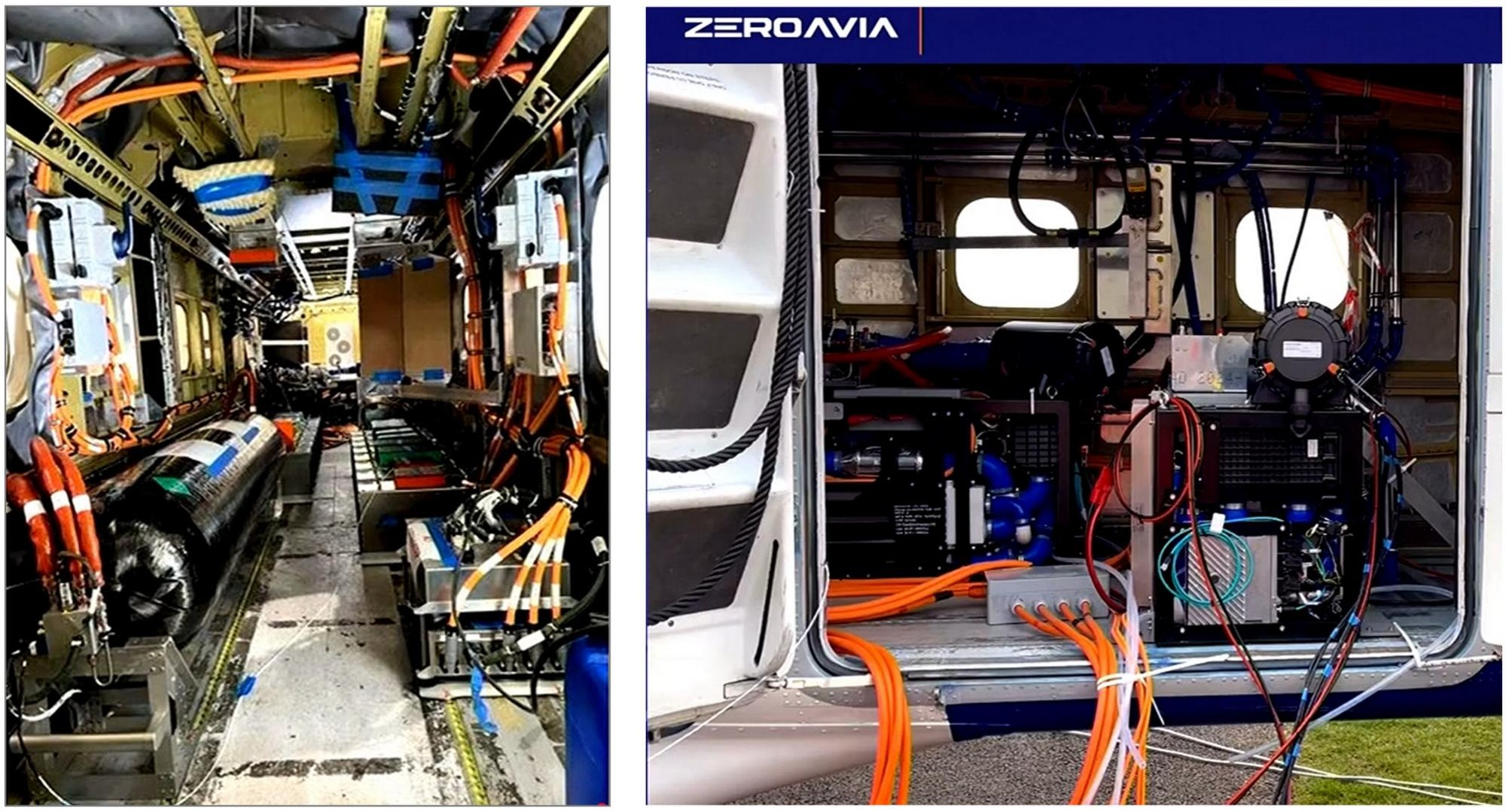
5kg of hydrogen contains the same energy as 17 litres of conventional jet fuel. Compare that with the fuel tanks of a Dornier 228, which hold 2,356 litres.
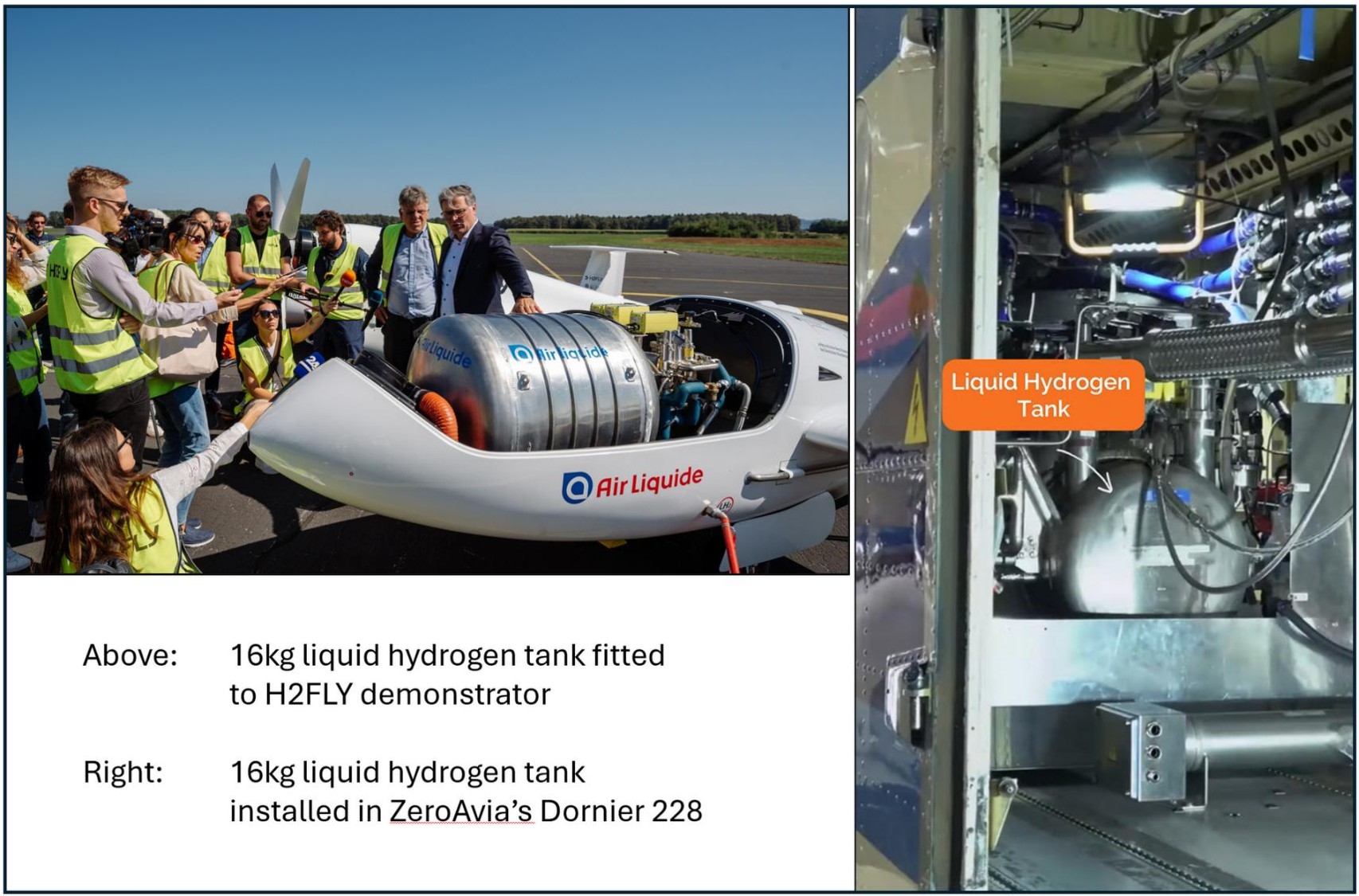
Recently a 16kg liquid hydrogen tank has been fitted. The new tank, first flown in 2023 by H2FLY, stores only as much energy as 56 litres of jet fuel - enough for a few minutes of flight. It took four hours to fill during the first test.
While useful progress has been demonstrated, the HyFlyer 2 program shows just how far ZeroAvia's technology is from commercial utility.
First commercial product: ZA600 in a Cessna Caravan
ZeroAvia plans to fit their ZA600 powertrain to Cessna Caravan aircraft. The company recently announced a €21.4m grant to support the retrofit of 15 aircraft, with operations to commence in 2028.
ZeroAvia's presentation to the RAeS made clear that there will be "a reduction of about 40% in the payload" because of the hydrogen systems.
As well as reduced payload, the aircraft will have reduced range (approx. 300nm vs 1070nm for a conventional Cessna Caravan) and higher fuel costs. The operating economics will be extremely challenging.
The target date of operations by 2028 is unrealistic given the development and certification status.
Certification: still at a very early stage
The first significant milestone in a certification project is to agree the 'certification basis'. This means that the applicant and the FAA agree which regulations need to be followed.
ZeroAvia agreed this first stage with the FAA in February 2025 (G-1 Issue Paper).
In the UK a preliminary step for certification is to obtain a 'Design Organisation Approval' (DOA). ZeroAvia received its DOA from the UK CAA in November 2025.
The G-1 and DOA milestones demonstrate engagement in the process, but they are the starting point, not an indication of impending approval. Given the novelty and complexity, certification will be slow and expensive.
'Green' hydrogen cost and infrastructure
In March 2023, in testimony to the US Senate, ZeroAvia claimed “a kilogram of clean hydrogen today can have a cost as low as $3”.
The reality is very different. Green hydrogen cost $5 to $7 per kg (DOE report from 2024). But that was for unpressurized, gaseous hydrogen at the point of production. Compression, liquefaction, transport to an airport and refuelling charges can be expected to more than double that cost. An allowance also needs to be made for losses through leakage, which will be significant.
The cost of green hydrogen is significantly higher than the cost of conventional jet fuel. Low-cost hydrogen is fossil-derived and offers no climate benefit.
Additionally, there is no hydrogen refuelling infrastructure. Aircraft like the Cessna Caravan typically operate between small airports in remote locations. These airports would all need hydrogen storage tanks, or on-site production facilities, as well as pumps, bowsers, systems to capture and re-liquefy hydrogen that boils off storage tanks, and so on. It is highly unlikely that this infrastructure will be deployed.
Recent downsizing
In 2024, ZeroAvia opened a 'Propulsion Center of Excellence' in the United States. Since August 2025, three rounds of layoffs have been reported.
In recent weeks, employees have announced their departure on LinkedIn or flagged their profiles as 'Open to Work'. Some of them are engineers who occupied critical roles, including:
- Head of HTPEM Product Development. (HTPEM refers to the high-temperature fuel cell systems with high power output - notably ZeroAvia's ZA2000.)
- Head of Power Generation Systems - LTPEM. (LTPEM refers to low-temperature fuel cell systems like the ZA600.)
- Head of HTPEM Test and Validation
- Principal Engineer Propulsion.
- Lead Airworthiness Engineer
- Hydrogen & Fuel Cell Technical Leader
- Senior Fuel Cell Engineer
- Lead Engineer - Electric Propulsion
While startups often adjust staffing as programmes evolve, it is unusual for a company with over 300 employees to lose multiple key engineers when at the early stages of a certification project which has received significant taxpayer funding.
Is there a future for ZeroAvia without hydrogen?
Hydrogen brings enormous difficulties for ZeroAvia, and offers few if any benefits to end users. It is extremely unlikely ever to become a significant energy source for aviation.
However, hydrogen is only one part of ZeroAvia's powertrain - and it is the part that currently relies extensively on 3rd party suppliers (fuel tanks, fuel cells, etc.).
ZeroAvia has developed technologies such as electric motors, inverters and power management systems that are directly applicable to pure electric or hybrid-electric aircraft, which have simpler and more advanced certification pathways.
It would be a bold change of direction for ZeroAvia to abandon hydrogen, but one that may offer a more realistic path to value creation.
Conclusion
The evidence shows a consistent gap between ZeroAvia's public forecasts and its technical and regulatory progress.
- The demonstrator aircraft are useful testbeds, but are not prototypes of certifiable systems.
- The certification process is at a very early stage, and it will be slow and expensive.
- Payload, range and operating economics will be extremely challenging for hydrogen-electric aircraft.
- Commercial service of hydrogen-electric powertrains in the next few years is not supported by the technical or regulatory evidence.
- ZeroAvia is losing key engineers at a critical stage in its certification project.
- ZeroAvia has developed expertise that could be valuable, but a strategic move away from hydrogen is probably unlikely.
The outlook is not encouraging. Investors and grant-giving bodies should be very cautious.
About the author:
Adrian Norris is an Aerospace consultant who specialises in helping investors make informed decisions and minimise risk. He has advised companies, private investors and VC funds in the US, Europe and China on investment in hydrogen aircraft and UAV projects. He was the co-founder of an aircraft development company and a satellite imaging company. He has a degree in Chemistry and is a Sloan Fellow of the London Business School.
Contact
Get in touch to discuss a current project or investment.
We provide independent, evidence-based analysis to support investment and strategic decisions.