
This article was first published on LinkedIn on March 24, 2026. Link to original article.
Beyond Aero Reality Check

Beyond Aero is a French startup that is developing a hydrogen-electric powered business aircraft. The company was founded in 2020, and it has made significant achievements:
- Flew a hydrogen-electric demonstrator aircraft in 2023
- Raised around $50 million in Seed and Series A funding
- Acquired IP and assets from Universal Hydrogen (a failed US startup that spent $100 million on a plan to convert regional airliners to hydrogen-electric propulsion)
- Hired an impressive engineering team with relevant certification experience.
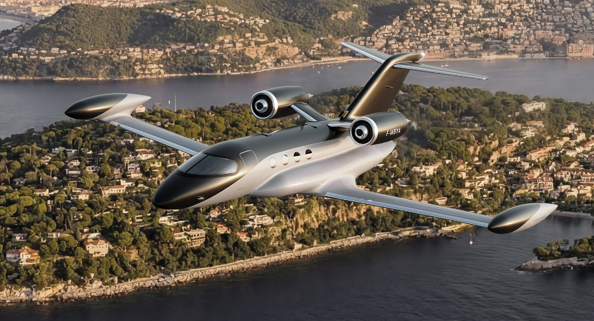
Last week Beyond Aero published the preliminary design of its aircraft, known as BYA-1. The design is detailed and credible, and the paper openly discusses the challenges of hydrogen-electric power. Such openness is vanishingly rare in the world of hydrogen-powered aviation, and it makes me want the company to succeed. But it won't.
Beyond Aero will fail.
Here’s why.
The Certification Game Changed
At Beyond Aero's last funding round, it was targeting CS-23 certification - the European regulatory standard for smaller general aviation aircraft. They maintained this target at least until October 2025. Press releases always stated that “the company is redesigning the architecture of a CS-23 aircraft around hydrogen-electric propulsion”.
That has now changed.
Beyond Aero’s design has put on weight, and it no longer fits under the 19,000lb (8,618kg) weight limit for CS-23. At 21,164lb (9,600kg) the BYA-1 has become a CS-25 aircraft. That is the regulatory standard for transport-category aircraft: large business jets and airliners.
Chief Engineer, Luiz Oliveira, was quoted in a recent Flight Global interview suggesting that there would be little impact to the change, although there could be “some additional engineering workload”.
From someone with Oliveira’s experience (44 years at Embraer), that is quite the understatement.
CS-25 is not a more demanding version of CS-23. It is a totally different regulatory world, with far more stringent requirements.
No privately-funded startup has ever achieved CS-25 (or the FAA equivalent, 14 CFR Part 25) certification as its first product. Not one. In the entire history of aviation.
Beyond Aero now faces three fundamental challenges:
- The certification standards for hydrogen-powered aircraft do not yet exist. Defining an agreed certification basis for the BYA-1 will be a slow and complex process.
- Once a certification basis is established, developing and certifying a safe, reliable hydrogen propulsion system will be highly challenging. There is no prior certification precedent, and regulators are likely to take a very cautious approach.
- The propulsion system must be certified in its own right, and the aircraft itself - with its advanced electric fly-by-wire flight control system - will require separate certification.
Any of these challenges would present a programme-defining challenge for a major OEM. Beyond Aero must solve all three simultaneously, on a startup budget.
Established OEMs typically require many years to certify a conventional CS-25 aircraft. Beyond Aero aims to deliver its aircraft from 2030. Compressing a far more complex programme into ~4 years is not credible.
Even if the timeline were credible, the funding is not.
The Funding Chasm
Beyond Aero has raised approximately $50 million.
A CS-25 certification programme for a conventional aircraft from an established OEM can cost billions of dollars.
Companies rarely disclose full costs, but some relevant comparisons are available:
- Dassault spent $1.3 billion on the Falcon 5X business jet, which never came to market.
- Dassault spent ~$700 million on the Falcon 8X, which is a derivative of their earlier 7X.
- In 2005, two years before its entry into service, Dassault reported having spent €700 million developing the 7X, which shared systems with earlier Dassault aircraft.
- Bombardier’s Global Express programme cost $800 million between 1991 and 1998.
- In 2010, Bombardier announced a $1 billion development cost for its Global 7500 and 8000 aircraft. (Development overran significantly, so actual costs are likely to have been higher.)
- In 2008, Cessna planned to spend $780 million on the Citation Columbus. (Programme was cancelled.)
- Honda is estimated to have spent $1.5 to $2 billion developing the HA420 HondaJet – and that is a Part 23 aircraft with much simpler certification requirements.
Those aircraft were all fairly conventional, and the manufacturers (except Honda) had huge experience of certification projects. The certification costs were generally offset by the high sale price of the aircraft – e.g. $60 million for the Dassault 8X, and over $80 million for the Bombardier Global 8000.
Beyond Aero will face greater challenges than these established manufacturers:
- It has no certification experience, and no existing supply chains.
- The programme requires development of new certification standards.
- The safety and reliability of the hydrogen propulsion system will need to be proven.
- The fully-electric fly-by-wire system will be hugely complicated to develop and certify. It will be a DAL A system under DO-178C/DO-254 - meaning that any failure could be catastrophic, resulting in loss of the aircraft. EASA will require absolute, documented proof that the software will not cause an accident. The development and testing costs will be enormous.
The realistic cost of Beyond Aero’s programme is $2-3 billion. Possibly more.
That is not what early investors signed up to, when they supported a CS-23 programme.
Beyond Aero's funding challenge is as big as their certification challenge.
All that might be worthwhile if Beyond Aero was producing an aircraft that would sell for tens of millions of dollars, and be sold in large volumes.
But they aren’t.
Even if they certify it, who will buy it?
Assume the impossible happens and Beyond Aero certifies the BYA-1 in 2030. What are operators buying?
The BYA-1 would offer zero emissions at the point of use, but operators would face compromises that are probably unacceptable.
Beyond Aero claim the BYA-1 will carry 6 passengers over 800nm at 300kt. But that would consume 185kg of hydrogen, out of the 193kg maximum capacity. When standard IFR reserves are taken into account, realistic operational range falls to approximately 500-600nm.
Compare that with a single-engine turboprop Pilatus PC-12, which can carry more people over a longer range at about the same speed. It costs ~$6 million.
A comparison between the BYA-1 and the PC-12 is instructive:
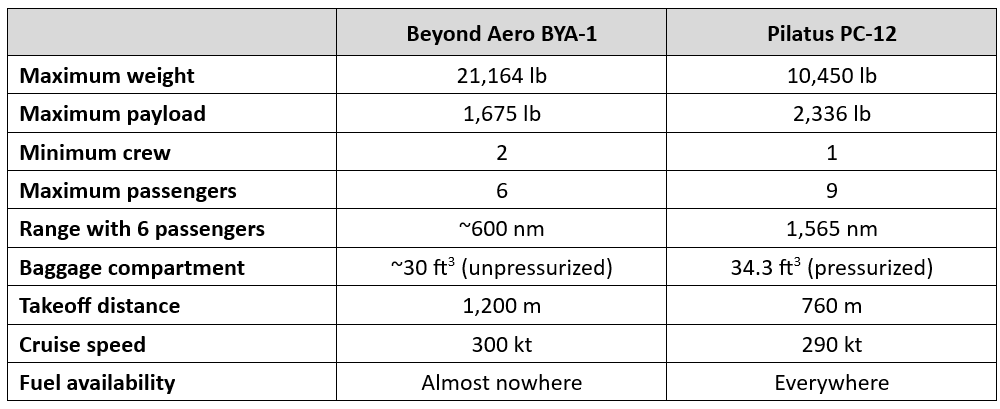
Beyond Aero claims its aircraft will be much cheaper to operate than conventional aircraft. They assume a cost of ~€5 per kg of green hydrogen, delivered to the aircraft, but current costs are roughly three times higher - and there are structural reasons why they will never fall to the levels Beyond Aero claim.
Beyond Aero’s heavy CS-25 aircraft will require two pilots. Aircraft with much better performance can be operated legally and more cheaply by a single pilot.
Then there is the infrastructure problem. The BYA-1 requires 700-bar hydrogen refuelling infrastructure that does not exist at any business aviation FBO in the world. The cost of installing and operating suitable refuelling systems is very high:
- In 2022, the US National Renewable Energy Laboratory estimated the capital cost of a 700-bar dispensing station, capable of delivering 2 tonnes of hydrogen per day, at $11 million.
- The operating cost, for 50% utilisation (i.e. 1 tonne per day - enough to fill five BYA-1 aircraft) would be $723,000 per year.
Aircraft operators would only be able to visit airports that had invested these amounts. Why would business airports do that, on the off-chance of selling hydrogen to BYA-1 owners?
Business aircraft users pay a substantial premium for one thing above all others: flexibility.
This aircraft cannot offer it.
The advisory board question
Beyond Aero has assembled a distinguished advisory board. It includes the former Head of General Aviation at EASA, the former CEO of Daher, a former SVP of Engineering at Airbus, the former structural design lead of the HondaJet programme and the former Sales Director at Dassault. These are people who have spent careers dealing with the problems Beyond Aero needs to solve.
Have any of them said stop?
The founders are young engineers who are building their professional identities around this project. I hope the advisors have explained the scale of the challenge clearly, and that they will guide the founders towards something more achievable.
A final word
The hydrogen aviation sector has consumed enormous capital, talent, and hope with no certified and operational hardware to show for it. Universal Hydrogen failed despite a credible team and significant funding. ZeroAvia has laid off many of its staff and cut back its plans, after years of optimistic claims and substantial investment.
Beyond Aero deserves credit for its honesty about the challenges, and for delivering a preliminary design that appears to offer the basis for a viable aircraft (although there are many technical issues that are not mentioned, or that require challenge). But that doesn't mean they have a viable path to certification, to market, or to commercial sustainability.
Beyond Aero’s team is talented and passionate. They deserve to be working on something achievable, not wasting their abilities on an impossible programme.
To any investor considering a future Beyond Aero funding round: the programme you would be funding is not the programme that was presented at the last raise. Please conduct your due diligence accordingly.
About the author:
Adrian Norris is a Partner at Alpha2 Consulting who specialises in helping investors make informed decisions and minimise risk. He has advised companies, private investors, VC and Private Equity funds in the US, Europe and China on investment in hydrogen aircraft and UAV projects. He was the co-founder of an aircraft development company and a satellite imaging company.
Contact
Get in touch to discuss a current project or investment.
We provide independent, evidence-based analysis to support investment and strategic decisions.